Closes#17194
This PR works around a crash when rendering opacity on `currentColor`
(as used by the placeholder styles in preflight) on Safari 16.4 and
Safari 16.5. Unfortunately it seems that the [`color-mix(…)` function is
not compatible with `currentColor` for these versions of
Safari](https://stackoverflow.com/questions/76436497/the-color-mix-property-involving-currentcolor-causes-safari-to-crash).
We tried a few different ways to work around this without success:
- Using an `@supports` media query to target these Safari versions and
overwriting the placeholder still makes these browsers crash.
- Changing the way we apply opacity to `currentColor` in core doesn't
seem to work for non-placeholder values:
https://github.com/tailwindlabs/tailwindcss/issues/17194#issuecomment-2728949181
However, a wrong opacity is still better than a complete browser crash.
The work-around of using the `oklab(…)` function does seem to work for
`::placeholder` styles in preflight though according to our testing so
this PR applies this change to preflight.
## Test plan
- See https://play.tailwindcss.com/WSsSTLHu8h?file=css
- Tested on Chrome/Safari 16.4/Safari 18.3/Firefox
<img width="564" alt="Screenshot 2025-03-17 at 11 32 47"
src="https://github.com/user-attachments/assets/cfd0db71-f39a-4bc0-bade-cea70afe50ae"
/>
Alternative to #16425Fixes#16585Fixes#16389Fixes#16252Fixes#15794Fixes#16646Fixes#16358
This PR changes the Vite plugin to use the file-system to discover
potential class names instead of relying on the module-graph. This comes
after a lot of testing and various issue reports where builds that span
different Vite instances were missing class names.
Because we now scan for candidates using the file-system, we can also
remove a lot of the bookkeeping necessary to make production builds and
development builds work as we no longer have to change the resulting
stylesheet based on the `transform` callbacks of other files that might
happen later.
This change comes at a small performance penalty that is noticeable
especially on very large projects with many files to scan. However, we
offset that change by fixing an issue that I found in the current Vite
integration that did a needless rebuild of the whole Tailwind root
whenever any source file changed. Because of how impactful this change
is, I expect many normal to medium sized projects to actually see a
performance improvement after these changes. Furthermore we do plan to
continue to use the module-graph to further improve the performance in
dev mode.
## Test plan
- Added new integration tests with cases found across the issues above.
- Manual testing by adding a local version of the Vite plugin to repos
from the issue list above and the [tailwindcss
playgrounds](https://github.com/philipp-spiess/tailwindcss-playgrounds).
This PR improves the integration tests in two ways:
1. Make the integration tests more reliable and thus less flakey
2. Make the integration tests faster (by introducing concurrency)

Tried a lot of different things to make sure that these tests are fast
and stable.

---

The biggest issue we noticed is that some tests are flakey, these are
tests with long running dev-mode processes where watchers are being used
and/or dev servers are created.
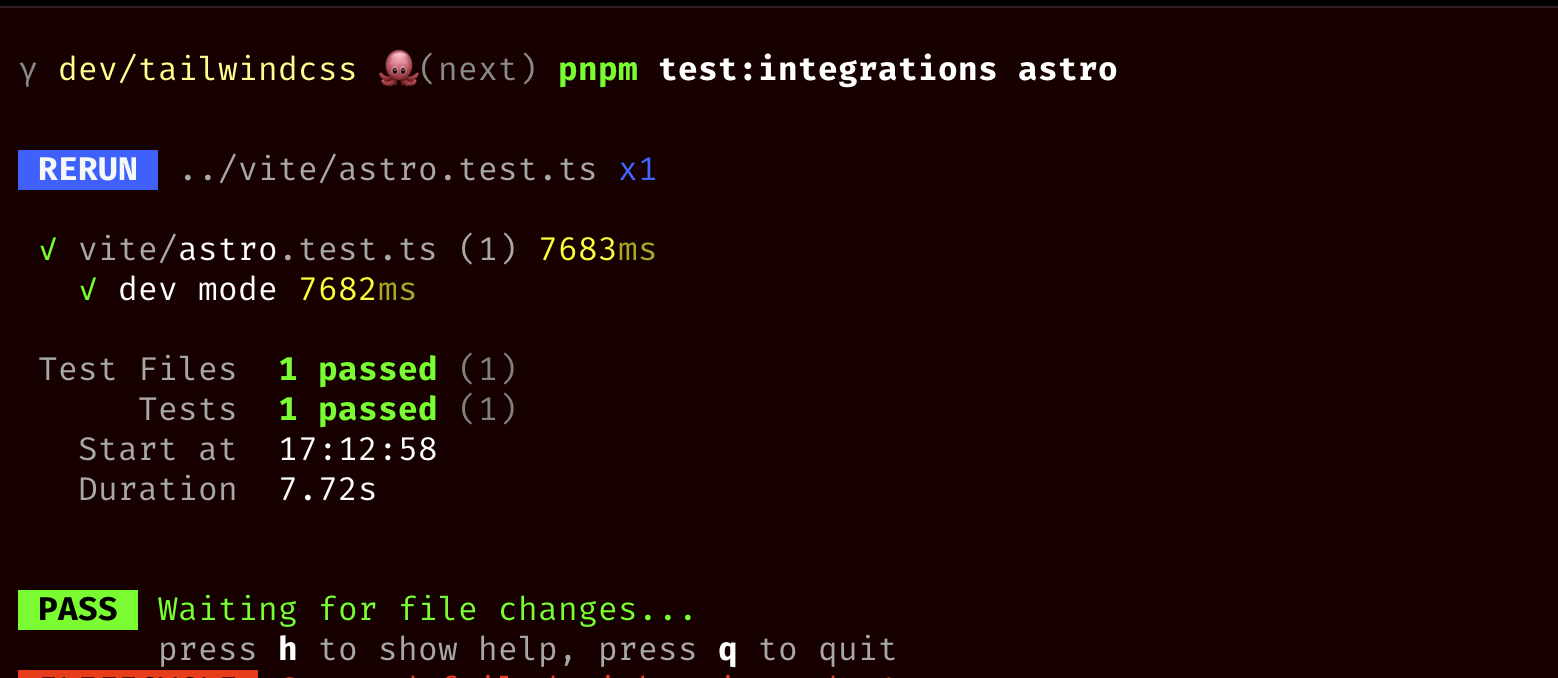
To solve this, all the tests that spawn a process look at stdout/stderr
and wait for a message from the process to know whether we can start
making changes.

For example, in case of an Astro project, you get a `watching for file
changes` message. In case of Nuxt project you can wait for an `server
warmed up in` and in case of Next.js there is a `Ready in` message.

These depend on the tools being used, so this is hardcoded per test
instead of a magically automatic solution.

These messages allow us to wait until all the initial necessary work,
internal watchers and/or dev servers are setup before we start making
changes to the files and/or request CSS stylesheets before the server(s)
are ready.

---

Another improvement is how we setup the dev servers. Before, we used to
try and get a free port on the system and use a `--port` flag or a
`PORT` environment variable. Instead of doing this (which is slow), we
rely on the process itself to show a URL with a port. Basically all
tools will try to find a free port if the default port is in use. We can
then use the stdout/stderr messages to get the URL and the port to use.

To reduce the amount of potential conflicts in ports, we used to run
every test and every file sequentially to basically guarantee that ports
are free. With this new approach where we rely on the process, I noticed
that we don't really run into this issue again (I reran the tests
multiple times and they were always stable)

<img width="316" alt="image"
src="https://github.com/user-attachments/assets/b75ddab4-f919-4995-85d0-f212b603e5c2"
/>
Note: these tests run Linux, Windows and macOS in this branch just for
testing purposes. Once this is done, we will only run Linux tests on PRs
and run all 3 of them on the `next` branch.

We do make the tests concurrent by default now, which in theory means
that there could be conflicts (which in practice means that the process
has to do a few more tries to find a free port). To reduce these
conflicts, we split up the integration tests such that Vite, PostCSS,
CLI, … tests all run in a separate job in the GitHub actions workflow.

<img width="312" alt="image"
src="https://github.com/user-attachments/assets/fe9a58a1-98eb-4d9b-8845-a7c8a7af5766"
/>

Comparing this branch against the `next` branch, this is what CI looks
like right now:

| `next` | `feat/improve-integration-tests` |
| --- | --- |
| <img width="594" alt="image"
src="https://github.com/user-attachments/assets/540d21eb-ab03-42e8-9f6f-b3a071fc7635"
/> | <img width="672" alt="image"
src="https://github.com/user-attachments/assets/8ef2e891-08a1-464b-9954-4153174ebce7"
/> |

There also was a point in time where I introduced sequential tests such
that all spawned processes still run after each other, but so far I
didn't run into issues if we keep them concurrent so I dropped that
code.

Some small changes I made to make things more reliable:
1. When relying on stdout/stderr messages, we split lines on `\n` and we
strip all the ANSI escapes which allows us to not worry about special
ANSI characters when finding the URL or a specific message to wait for.
2. Once a test is done, we `child.kill()` the spawned process. If that
doesn't work, for whatever reason, we run a `child.kill('SIGKILL')` to
force kill the process. This could technically lead to some memory or
files not being cleaned up properly, but once CI is done, everything is
thrown away anyway.
3. As you can see in the screenshots, I used some nicer names for the
workflows.

| `next` | `feat/improve-integration-tests` |
| --- | --- |
| <img width="276" alt="image"
src="https://github.com/user-attachments/assets/e574bb53-e21b-4619-9cdb-515431b255b9"
/> | <img width="179" alt="image"
src="https://github.com/user-attachments/assets/8bc75119-fb91-4500-a1d0-bd09f74c93ad"
/> |

They also look a bit nicer in the PR overview as well:
<img width="929" alt="image"
src="https://github.com/user-attachments/assets/04fc71fc-74b0-4e7c-9047-2aada664efef"
/>

The very last commit just filters out Windows and macOS tests again for
PRs (but they are executed on the `next` branch.

---

### Nest steps

I think for now we are in a pretty good state, but there are some things
we can do to further improve everything (mainly make things faster) but
aren't necessary. I also ran into issue while trying it so there is more
work to do.

1. More splits — instead of having a Vite folder and PostCSS folder, we
can go a step further and have folders for Next.js, Astro, Nuxt, Remix,
…
2. Caching — right now we have to run the build step for every OS on
every "job". We can re-use the work here by introducing a setup job that
the other jobs rely on. @thecrypticace and I tried it already, but were
running into some Bun specific Standalone CLI issues when doing that.
3. Remote caching — we could re-enable remote caching such that the
`build` step can be full turbo (e.g.: after a PR is merged in `next` and
we run everything again)
There are still instances in which CI is flaky after #14332. This PR
applies the same fix (that is, moving the file write into the retrying
block) to all `retryAssertion` callbacks.
This works similar to the Vue setup. The styles that Astro will receive
might still contain Tailwind CSS APIs but since it's not picky, we can
pass that through to the regular Vite `transform` handlers for now.

This, however, will have issues like
https://github.com/tailwindlabs/tailwindcss/issues/14205. We have to fix
this together with Vue and other similar extensions later. For now, it
will break when syntax is used that lightningcss rewrites (like `@apply
text-3xl/tight;`)

---------

Co-authored-by: Jordan Pittman <jordan@cryptica.me>