mirror of
https://github.com/trekhleb/javascript-algorithms.git
synced 2025-12-08 19:06:00 +00:00
 d6b8dd394a
* chore(factorial): translation fr-FR

* feat(math-translation-fr-FR): fast powering

* feat(math-translation-fr-FR): fibonacci numbers

* chore(math-translation-fr-FR): bits

* chore(math-translation-fr-FR): complex number

* chore(math-translation-fr-FR): euclidean algorithm

* chore(math-translation-fr-FR): fibonacci number

* chore(math-translation-fr-FR): fourier transform

* chore(math-translation-fr-FR): fourier transform WIP

* chore(math-translation-fr-FR): fourier transform done

* chore(math-translation-fr-FR): fourier transform in menu
74 lines
2.1 KiB
Markdown
74 lines
2.1 KiB
Markdown
# Algorithme d'exponentiation rapide
|
||
|
||
_Read this in other languages:_
|
||
[english](README.md).
|
||
|
||
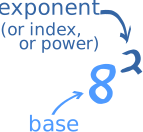
En algèbre, une **puissance** d'un nombre est le résultat de la multiplication répétée de ce nombre avec lui-même.
|
||
|
||
Elle est souvent notée en assortissant le nombre d'un entier, typographié en exposant, qui indique le nombre de fois qu'apparaît le nombre comme facteur dans cette multiplication.
|
||
|
||
|
||
|
||
## Implémentation « naïve »
|
||
|
||
Comment trouver `a` élevé à la puissance `b` ?
|
||
|
||
On multiplie `a` avec lui-même, `b` nombre de fois.
|
||
Ainsi, `a^b = a * a * a * ... * a` (`b` occurrences de `a`).
|
||
|
||
Cette opération aura un complexité linéaire, notée `O(n)`,
|
||
car la multiplication aura lieu exactement `n` fois.
|
||
|
||
## Algorithme d'exponentiation rapide
|
||
|
||
Peut-on faire mieux que cette implémentation naïve?
|
||
Oui, on peut réduire le nombre de puissance à un complexité de `O(log(n))`.
|
||
|
||
Cet algorithme utilise l'approche « diviser pour mieux régner »
|
||
pour calculer cette puissance.
|
||
En l'état, cet algorithme fonctionne pour deux entiers positifs `X` et `Y`.
|
||
|
||
L'idée derrière cet algorithme est basée sur l'observation suivante.
|
||
|
||
Lorsque `Y` est **pair**:
|
||
|
||
```text
|
||
X^Y = X^(Y/2) * X^(Y/2)
|
||
```
|
||
|
||
Lorsque `Y` est **impair**:
|
||
|
||
```text
|
||
X^Y = X^(Y//2) * X^(Y//2) * X
|
||
où Y//2 est le résultat de la division entière de Y par 2.
|
||
```
|
||
|
||
**Par exemple**
|
||
|
||
```text
|
||
2^4 = (2 * 2) * (2 * 2) = (2^2) * (2^2)
|
||
```
|
||
|
||
```text
|
||
2^5 = (2 * 2) * (2 * 2) * 2 = (2^2) * (2^2) * (2)
|
||
```
|
||
|
||
Ainsi, puisqu'à chaque étape on doits calculer
|
||
deux fois la même puissance `X ^ (Y / 2)`,
|
||
on peut optimiser en l'enregistrant dans une variable intermédiaire
|
||
pour éviter son calcul en double.
|
||
|
||
**Complexité en temps**
|
||
|
||
Comme à chaque itération nous réduisons la puissance de moitié,
|
||
nous appelons récursivement la fonction `log(n)` fois. Le complexité de temps de cet algorithme est donc réduite à:
|
||
|
||
```text
|
||
O(log(n))
|
||
```
|
||
|
||
## Références
|
||
|
||
- [YouTube](https://www.youtube.com/watch?v=LUWavfN9zEo&index=80&list=PLLXdhg_r2hKA7DPDsunoDZ-Z769jWn4R8&t=0s)
|
||
- [Wikipedia](https://fr.wikipedia.org/wiki/Exponentiation_rapide)
|