 6d6c6792f1
* checkpoint vitepress docs

* edits

* edits

* hero drop shadow

* d3-array edits

* resolve d3

* split d3-array

* move d3-array stuff around

* d3-array is collapsed: true

* italicize parameter names

* searching edits

* update dependencies

* d3-array edits

* array edits

* array edits

* array edits

* array edits

* array edits

* move files

* array edits

* array edits

* array edits

* getting started edits

* modules page

* array edits

* more structure

* live example

* dsv edits

* fetch edits

* dsv edits

* random edits

* time format edits

* time edits

* time edits

* modules edits

* color edits

* color edits

* interpolate edits

* scale-chromatic edits

* selection edits

* break up d3-interpolate

* scale edits

* time scale edits

* scale edits

* scale edits

* band edits

* band edits

* more descriptive titles

* band and point edits

* sequential edits

* diverging edits

* quantize edits

* quantile edits

* threshold edits

* doc edits

* fix titles

* sequential edits

* axis edits

* axis edits

* axis edits

* shape edits

* shape edits

* dark mode chart

* dark mode chart

* curve edits

* interpolate edits

* line edits

* link edits

* radial edits

* pie edits

* symbol edits

* stack edits

* stack examples

* path edits

* polygon edits

* quadtree edits

* random examples

* ease edits

* ease edits

* ease edits

* timer edits

* delaunay edits

* quadtree find example

* voronoi edits

* dispatch edits

* contour edits

* chord edits

* chord edits

* fix find highlight

* quadtree animation

* transition edits

* transition edits

* transition edits

* zoom edits

* drag edits

* brush edits

* force edits

* voronoi neighbors example

* hierarchy edits

* api edits

* community edits

* getting started edits

* geo edits

* Add short "D3 in React" section (#3659)

* Add short "D3 in React" section

I know you removed the TODO but I was already trying to fill it in! I think just making the distinction of modules that touch the DOM and those that don't was super clarifying for me personally when I figured that out. And I always forget the most basic ref pattern (and still might've messed it up here). I don't think we should get into updating or interactivity or whatever, but I think just this much goes a long way toward demystifying (and showing just the most basic best practices).

* forgot i made data generic, rm reference to normal distribution

* useEffect cleans up after itself

Co-authored-by: Mike Bostock <mbostock@gmail.com>

* Update getting-started.md

---------

Co-authored-by: Mike Bostock <mbostock@gmail.com>

* build fixes

* index edits

---------

Co-authored-by: Toph Tucker <tophtucker@gmail.com>
4.6 KiB
Pack
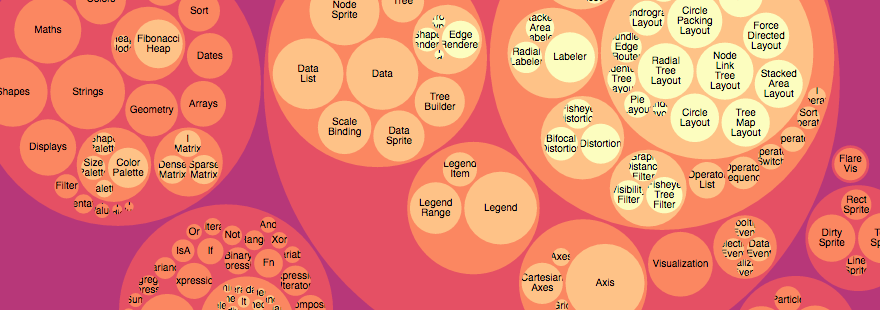
Examples · Enclosure diagrams use containment (nesting) to represent a hierarchy. The size of the leaf circles encodes a quantitative dimension of the data. The enclosing circles show the approximate cumulative size of each subtree, but due to wasted space there is some distortion; only the leaf nodes can be compared accurately. Although circle packing does not use space as efficiently as a treemap, the “wasted” space more prominently reveals the hierarchical structure.
pack()
Source · Creates a new pack layout with the default settings.
pack(root)
Source · Lays out the specified root hierarchy, assigning the following properties on root and its descendants:
- node.x - the x-coordinate of the circle’s center
- node.y - the y coordinate of the circle’s center
- node.r - the radius of the circle
You must call root.sum before passing the hierarchy to the pack layout. You probably also want to call root.sort to order the hierarchy before computing the layout.
pack.radius(radius)
Source · If radius is specified, sets the pack layout’s radius accessor to the specified function and returns this pack layout. If radius is not specified, returns the current radius accessor, which defaults to null. If the radius accessor is null, the radius of each leaf circle is derived from the leaf node.value (computed by node.sum); the radii are then scaled proportionally to fit the layout size. If the radius accessor is not null, the radius of each leaf circle is specified exactly by the function.
pack.size(size)
Source · If size is specified, sets this pack layout’s size to the specified two-element array of numbers [width, height] and returns this pack layout. If size is not specified, returns the current size, which defaults to [1, 1].
pack.padding(padding)
Source · If padding is specified, sets this pack layout’s padding accessor to the specified number or function and returns this pack layout. If padding is not specified, returns the current padding accessor, which defaults to the constant zero. When siblings are packed, tangent siblings will be separated by approximately the specified padding; the enclosing parent circle will also be separated from its children by approximately the specified padding. If an explicit radius is not specified, the padding is approximate because a two-pass algorithm is needed to fit within the layout size: the circles are first packed without padding; a scaling factor is computed and applied to the specified padding; and lastly the circles are re-packed with padding.
packSiblings(circles)
Source · Packs the specified array of circles, each of which must have a circle.r property specifying the circle’s radius. Assigns the following properties to each circle:
- circle.x - the x-coordinate of the circle’s center
- circle.y - the y coordinate of the circle’s center
The circles are positioned according to the front-chain packing algorithm by Wang et al.
packEnclose(circles)
Examples · Source · Computes the smallest circle that encloses the specified array of circles, each of which must have a circle.r property specifying the circle’s radius, and circle.x and circle.y properties specifying the circle’s center. The enclosing circle is computed using the Matoušek-Sharir-Welzl algorithm. (See also Apollonius’ Problem.)