Fixes#14784
This is an alternative to #14850 in which we actually perform url
rewriting / rebasing ourselves. We ported a large portion of the
URL-rewriting code from Vite (with attribution) to use here with some
minor modifications. We've added test cases for the url rewriting so
verifying individual cases is easy. We also wrote integration tests for
Vite that use PostCSS and Lightning CSS that verify that files are found
and inlined or relocated/renamed as necessary.
We also did some manual testing in the Playground to verify that this
works as expected across several CSS files and directories which you can
see a screenshot from here:
<img width="1344" alt="Screenshot 2024-11-05 at 10 25 16"
src="https://github.com/user-attachments/assets/ff0b3ac8-cdc9-4e26-af79-36396a5b77b9">
---------
Co-authored-by: Philipp Spiess <hello@philippspiess.com>
This PR introduces a new `source(…)` argument and improves on the
existing `@source`. The goal of this PR is to make the automatic source
detection configurable, let's dig in.

By default, we will perform automatic source detection starting at the
current working directory. Auto source detection will find plain text
files (no binaries, images, ...) and will ignore git-ignored files.

If you want to start from a different directory, you can use the new
`source(…)` next to the `@import "tailwindcss/utilities"
layer(utilities) source(…)`.

E.g.:

```css
/* ./src/styles/index.css */
@import 'tailwindcss/utilities' layer(utilities) source('../../');
```

Most people won't split their source files, and will just use the simple
`@import "tailwindcss";`, because of this reason, you can use
`source(…)` on the import as well:

E.g.:

```css
/* ./src/styles/index.css */
@import 'tailwindcss' source('../../');
```

Sometimes, you want to rely on auto source detection, but also want to
look in another directory for source files. In this case, yuo can use
the `@source` directive:

```css
/* ./src/index.css */
@import 'tailwindcss';

/* Look for `blade.php` files in `../resources/views` */
@source '../resources/views/**/*.blade.php';
```

However, you don't need to specify the extension, instead you can just
point the directory and all the same automatic source detection rules
will apply.

```css
/* ./src/index.css */
@import 'tailwindcss';

@source '../resources/views';
```

If, for whatever reason, you want to disable the default source
detection feature entirely, and only want to rely on very specific glob
patterns you define, then you can disable it via `source(none)`.

```css
/* Completely disable the default auto source detection */
@import 'tailwindcss' source(none);

/* Only look at .blade.php files, nothing else  */
@source "../resources/views/**/*.blade.php";
```

Note: even with `source(none)`, if your `@source` points to a directory,
then auto source detection will still be performed in that directory. If
you don't want that, then you can simply add explicit files in the globs
as seen in the previous example.

```css
/* Completely disable the default auto source detection */
@import 'tailwindcss' source(none);

/* Run auto source detection in `../resources/views` */
@source "../resources/views";
```

---------

Co-authored-by: Jordan Pittman <jordan@cryptica.me>
Co-authored-by: Adam Wathan <4323180+adamwathan@users.noreply.github.com>
This PR fixes an issue when trying to resolve plugins with `exports` in
their `package.json`, like `@headlessui/tailwindcss`. The missing
`conditionNames` in the enhanced resolver config would cause it to not
properly look up the name.
## Test Plan
I added a test using the `postcss` setup (the existing plugin tests are
inside the CLI setup but the CLI can only ever run in Module JS mode).
To ensure the tests are resolving to the right environment (CJS vs MJS),
I added logging of the `import.meta.url` value to the resolver code.
When run, this was the output:
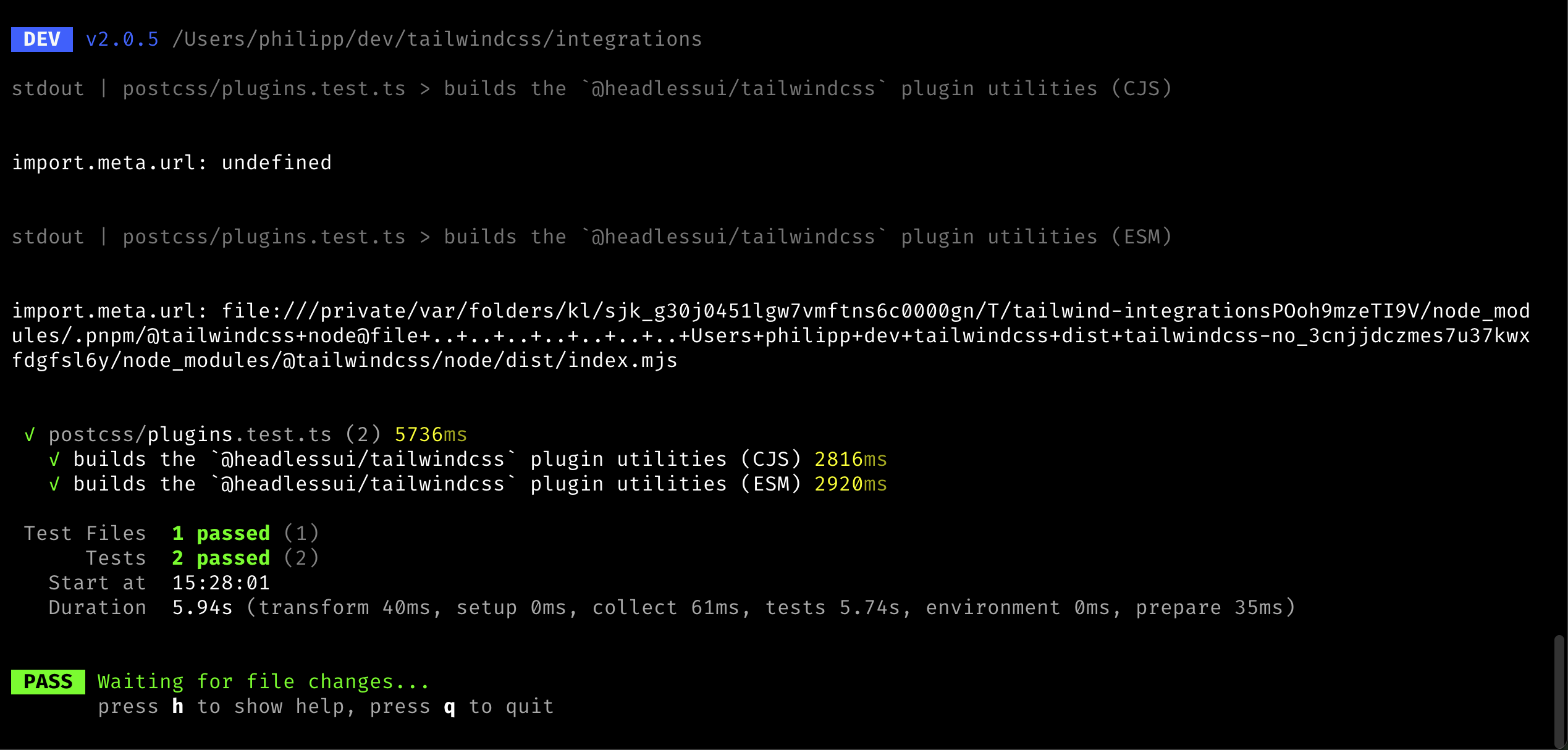
Co-authored-by: Adam Wathan <adam.wathan@gmail.com>
When we implemented the CSS import resolution system, we found out a
detail about CSS imports in that files without a relative path prefix
would still be relative to the source file. E.g.:

```css
@import 'foo.css';
```

Should first look for the file `foo.css` in the same directory. To make
this cost as cheap as possible, we limited this by a heuristics to only
apply the auto-relative imports for files with a file extension.

Naturally, while testing v4 on more templates, we found that it's common
for people to omit the file extension when loading css file. The above
could also be written as such:

```css
@import 'foo';
```

To improve this, we have two options:

- We either remove the heuristics, making every `@import` more expensive
because we have to check for relative files.
- We upgrade our codemods to rewrite `@import` statements to be
explicitly relative.

Because we really care about performance, we opted to go with the latter
option. This PR adds the codemod and removes the heuristics so we
resolve CSS files similar to how you would resolve JS files.

---------

Co-authored-by: Robin Malfait <malfait.robin@gmail.com>
Co-authored-by: Adam Wathan <adam.wathan@gmail.com>
This PR improves the performance of the `@tailwindcss/postcss` plugin.
Before this change we created 2 compiler instances instead of a single
one. On a project where a `tailwindcss.config.ts` file is used, this
means that the timings look like this:

```
[@tailwindcss/postcss] Setup compiler: 137.525ms
⋮
[@tailwindcss/postcss] Setup compiler: 43.95ms
```

This means that with this small change, we can easily shave of ~50ms for
initial PostCSS builds.

---------

Co-authored-by: Philipp Spiess <hello@philippspiess.com>
Co-authored-by: Jordan Pittman <jordan@cryptica.me>
This PR adds a new migration that can migrate Tailwind CSS v3 style
prefixes into Tailwind CSS v4.

The migration is split into three separate pieces of work:

1. Firstly, we need to read the full JavaScript config to get the _old_
prefix option. This is necessary because in v4, we will not allow things
like custom-separators for the prefix. From this option we will then try
and compute a new prefix (in 90% of the cases this is going to just
remove the trailing `-` but it can also work in more complex cases).
2. Then we migrate all Candidates. The important thing here is that we
need to operate on the raw candidate string because by relying on
`parseCandidate` (which we do for all other migrations) would not work,
as the candidates are not valid in v4 syntax. More on that in a bit.
3. Lastly we also make sure to update the CSS config to include the new
prefix. This is done by prepending the prefix option like so:

    ```css
    @import "tailwindcss" prefix(tw);
    ```

### Migrating candidates

The main difference between v3 prefixes and v4 prefixes is that in v3,
the prefix was _part of the utility_ where as in v4 it is _always in
front of the CSS class.

So, for example, this candidate in v3:

```
hover:-tw-mr-4
```

Would be converted to the following in v4:

```
tw:hover:-mr-4
```

Since the first example _won't parse as a valid Candidate in v4, as the
`tw-mr` utility does not exist, we have to operate on the raw candidate
string first. To do this I created a fork of the `parseCandidate`
function _without any validation of utilities or variants_. This is used
to identify part of the candidate that is the `base` and then ensuring
the `base` starts with the old prefix. We then remove this to create an
"unprefixed" candidate that we validate against a version of the
DesignSystem _with no prefixes configured_. If the variant is valid this
way, we can then print it again with the `DesignSystem` that has the new
prefix to get the migrated version.

Since we set up the `DesignSystem` to include the new prefix, we can
also be certain that migrations that happen afterwards would still
disqualify candidates that aren't valid according to the new prefix
policy. This does mean we need to have the prefix fixup be the first
step in our pipeline.

One interesting bit is that in v3, arbitrary properties did not require
prefixes where as in v4 they do. So the following candidate:

```
[color:red]
```

Will be converted to:

```
tw:[color:red]
```
This PR exposes when using the the `DEBUG` environment variable. This
follows the `DEBUG` conventions where:

- `DEBUG=1`
- `DEBUG=true`
- `DEBUG=*`
- `DEBUG=tailwindcss`

Will enable the debug information, but when using:

- `DEBUG=0`
- `DEBUG=false`
- `DEBUG=-tailwindcss`

It will not.

This currently only exposes some timings related to:

1. Scanning for candidates
2. Building the CSS
3. Optimizing the CSS

We can implement a more advanced version of this where we also expose
more fine grained information such as the files we scanned, the amount
of candidates we found and so on. But I believe that this will be enough
to start triaging performance related issues.
This PR adds the initial setup and a first codemod for the template
migrations. These are a new set of migrations that operate on files
defined in the Tailwind v3 config as part of the `content` option (so
your HTML, JavaScript, TSX files etc.).

The migration for this is integrated in the new `@tailwindcss/upgrade`
package and will require pointing the migration to an input JavaScript
config file, like this:

```
npx @tailwindcss/upgrade --config tailwind.config.js
```

The idea of template migrations is to apply breaking changes from the v3
to v4 migration within your template files.

## Migrating !important syntax

The first migration that I’m adding with this PR is to ensure we use the
v4 important syntax that has the exclamation mark at the end of the
utility.

For example, this:

```html
<div class="!flex sm:!block"></div>
```

Will now turn into:

```html
<div class="flex! sm:block!"></div>
```

## Architecture considerations

Implementation wise, we make use of Oxide to scan the content files fast
and efficiently. By relying on the same scanner als Tailwind v4, we
guarantee that all candidates that are part of the v4 output will have
gone through a migration.

Migrations itself operate on the abstract `Candidate` type, similar to
the type we use in the v4 codebase. It will parse the candidate into its
parts so they can easily be introspected/modified. Migrations are typed
as:

```ts
type TemplateMigration = (candidate: Candidate) => Candidate | null
```

`null` should be returned if the `Candidate` does not need a migration.

We currently use the v4 `parseCandidate` function to get an abstract
definition of the candidate rule that we can operate on. _This will
likely need to change in the future as we need to fork `parseCandidate`
for v3 specific syntax_.

Additionally, we're inlining a `printCandidate` function that can
stringify the abstract `Candidate` type. It is not guaranteed that this
is an identity function since some information can be lost during the
parse step. This is not a problem though, because migrations will only
run selectively and if none of the selectors trigger, the candidates are
not updated. h/t to @RobinMalfait for providing the printer.

So the overall flow of a migration looks like this:

- Scan the config file for `content` files
- Use Oxide to extract a list of candidate and their positions from
these `content` files
- Run a few migrations that operate on the `Candidate` abstract type.
- Print the updated `Candidate` back into the original `content` file.

---------

Co-authored-by: Robin Malfait <malfait.robin@gmail.com>
Co-authored-by: Jordan Pittman <jordan@cryptica.me>
This PR brings `@import` resolution into Tailwind CSS core. This means
that our clients (PostCSS, Vite, and CLI) no longer need to depend on
`postcss` and `postcss-import` to resolve `@import`. Furthermore this
simplifies the handling of relative paths for `@source`, `@plugin`, or
`@config` in transitive CSS files (where the relative root should always
be relative to the CSS file that contains the directive). This PR also
fixes a plugin resolution bug where non-relative imports (e.g. directly
importing node modules like `@plugin '@tailwindcss/typography';`) would
not work in CSS files that are based in a different npm package.

### Resolving `@import`

The core of the `@import` resolution is inside
`packages/tailwindcss/src/at-import.ts`. There, to keep things
performant, we do a two-step process to resolve imports. Imagine the
following input CSS file:

```css
@import "tailwindcss/theme.css";
@import "tailwindcss/utilities.css";
```

Since our AST walks are synchronous, we will do a first traversal where
we start a loading request for each `@import` directive. Once all loads
are started, we will await the promise and do a second walk where we
actually replace the AST nodes with their resolved stylesheets. All of
this is recursive, so that `@import`-ed files can again `@import` other
files.

The core `@import` resolver also includes extensive test cases for
[various combinations of media query and supports conditionals as well
als layered
imports](https://developer.mozilla.org/en-US/docs/Web/CSS/@import).

When the same file is imported multiple times, the AST nodes are
duplicated but duplicate I/O is avoided on a per-file basis, so this
will only load one file, but include the `@theme` rules twice:

```css
@import "tailwindcss/theme.css";
@import "tailwindcss/theme.css";
```

### Adding a new `context` node to the AST

One limitation we had when working with the `postcss-import` plugin was
the need to do an additional traversal to rewrite relative `@source`,
`@plugin`, and `@config` directives. This was needed because we want
these paths to be relative to the CSS file that defines the directive
but when flattening a CSS file, this information is no longer part of
the stringifed CSS representation. We worked around this by rewriting
the content of these directives to be relative to the input CSS file,
which resulted in added complexity and caused a lot of issues with
Windows paths in the beginning.

Now that we are doing the `@import` resolution in core, we can use a
different data structure to persist this information. This PR adds a new
`context` node so that we can store arbitrary context like this inside
the Ast directly. This allows us to share information with the sub tree
_while doing the Ast walk_.

Here's an example of how the new `context` node can be used to share
information with subtrees:

```ts
const ast = [
  rule('.foo', [decl('color', 'red')]),
  context({ value: 'a' }, [
    rule('.bar', [
      decl('color', 'blue'),
      context({ value: 'b' }, [
        rule('.baz', [decl('color', 'green')]),
      ]),
    ]),
  ]),
]

walk(ast, (node, { context }) => {
  if (node.kind !== 'declaration') return
  switch (node.value) {
    case 'red':   assert(context.value === undefined)
    case 'blue':  assert(context.value === 'a')
    case 'green': assert(context.value === 'b')
  }
})
```

In core, we use this new Ast node specifically to persist the `base`
path of the current CSS file. We put the input CSS file `base` at the
root of the Ast and then overwrite the `base` on every `@import`
substitution.

### Removing the dependency on `postcss-import`

Now that we support `@import` resolution in core, our clients no longer
need a dependency on `postcss-import`. Furthermore, most dependencies
also don't need to know about `postcss` at all anymore (except the
PostCSS client, of course!).

This also means that our workaround for rewriting `@source`, the
`postcss-fix-relative-paths` plugin, can now go away as a shared
dependency between all of our clients. Note that we still have it for
the PostCSS plugin only, where it's possible that users already have
`postcss-import` running _before_ the `@tailwindcss/postcss` plugin.

Here's an example of the changes to the dependencies for our Vite client
✨ :

<img width="854" alt="Screenshot 2024-09-19 at 16 59 45"
src="https://github.com/user-attachments/assets/ae1f9d5f-d93a-4de9-9244-61af3aff1237">

### Performance

Since our Vite and CLI clients now no longer need to use `postcss` at
all, we have also measured a significant improvement to the initial
build times. For a small test setup that contains only a hand full of
files (nothing super-complex), we measured an improvement in the
**3.5x** range:

<img width="1334" alt="Screenshot 2024-09-19 at 14 52 49"
src="https://github.com/user-attachments/assets/06071fb0-7f2a-4de6-8ec8-f202d2cc78e5">

The code for this is in the commit history if you want to reproduce the
results. The test was based on the Vite client.

### Caveats

One thing to note is that we previously relied on finding specific
symbols in the input CSS to _bail out of Tailwind processing
completely_. E.g. if a file does not contain a `@tailwind` or `@apply`
directive, it can never be a Tailwind file.

Since we no longer have a string representation of the flattened CSS
file, we can no longer do this check. However, the current
implementation was already inconsistent with differences on the allowed
symbol list between our clients. Ideally, Tailwind CSS should figure out
wether a CSS file is a Tailwind CSS file. This, however, is left as an
improvement for a future API since it goes hand-in-hand with our planned
API changes for the core `tailwindcss` package.

---------

Co-authored-by: Jordan Pittman <jordan@cryptica.me>
<!--

👋 Hey, thanks for your interest in contributing to Tailwind!

**Please ask first before starting work on any significant new
features.**

It's never a fun experience to have your pull request declined after
investing a lot of time and effort into a new feature. To avoid this
from happening, we request that contributors create an issue to first
discuss any significant new features. This includes things like adding
new utilities, creating new at-rules, or adding new component examples
to the documentation.


https://github.com/tailwindcss/tailwindcss/blob/master/.github/CONTRIBUTING.md

-->

```ts
// error: can't find `@tailwindcss/node` types file
import { compile } from '@tailwindcss/node';
```
Tailwind V3 used [jiti](https://github.com/unjs/jiti/) to allow
importing of TypeScript files for the config and plugins. This PR adds
the new Jiti V2 beta to our `@tailwindcss/node` and uses it if a native
`import()` fails. I added a new integration test to the CLI config
setup, to ensure it still works with our module cache cleanup.
<!--

👋 Hey, thanks for your interest in contributing to Tailwind!

**Please ask first before starting work on any significant new
features.**

It's never a fun experience to have your pull request declined after
investing a lot of time and effort into a new feature. To avoid this
from happening, we request that contributors create an issue to first
discuss any significant new features. This includes things like adding
new utilities, creating new at-rules, or adding new component examples
to the documentation.


https://github.com/tailwindcss/tailwindcss/blob/master/.github/CONTRIBUTING.md

-->

Co-authored-by: Adam Wathan <4323180+adamwathan@users.noreply.github.com>
In Tailwind v4 the CSS file is the main entry point to your project and
is generally configured via `@theme`. However, given that all v3
projects were configured via a `tailwind.config.js` file we definitely
need to support those. This PR adds support for loading existing
Tailwind config files by adding an `@config` directive to the CSS —
similar to how v3 supported multiple config files except that this is
now _required_ to use a config file.

You can load a config file like so:

```
@import "tailwindcss";
@config "./path/to/tailwind.config.js";
```

A few notes:
- Both CommonJS and ESM config files are supported (loaded directly via
`import()` in Node)
- This is not yet supported in Intellisense or Prettier — should
hopefully land next week
- TypeScript is **not yet** supported in the config file — this will be
handled in a future PR.

---------

Co-authored-by: Philipp Spiess <hello@philippspiess.com>
Co-authored-by: Adam Wathan <adam.wathan@gmail.com>
Co-authored-by: Robin Malfait <malfait.robin@gmail.com>


