Fixes#16233
Vite has a number of special parameters that can be appended to `.css`
files that make it actually load as a JavaScript module. One such
parameter that we haven't handled before is the `?commonjs-proxy` flag.
When importing e.g. `plotly.js/lib/core`, the dependency tree would
eventually load a file called `*.css?commonjs-proxy`. We previously
scanned this for candidates even though it was not, in-fact, a
stylesheet.
This PR fixes this by adding the `?commonjs-proxy` to the ignore list. I
have also updated `SPECIAL_QUERY_RE` to more closely match the Vite
implementation. It does seem like this was the only condition we were
missing, though:
2b2299cbac/packages/vite/src/node/plugins/css.ts (L511-L517)
## Test plan
Add and import `plotly.js/lib/core` into a Vite app. I also added an
integration test to do that.
Co-authored-by: Robin Malfait <malfait.robin@gmail.com>
Fixes#16036
This adds a new rule to treat `<style>` blocks found within `.html` file
as Tailwind CSS targets.
## Test plan
- Tested using the Vite extension (dev) and a new integration test
(prod)
Co-authored-by: Robin Malfait <malfait.robin@gmail.com>
Fixes#16045
This PR fixes two Vite issues found with SolidStart:
- SolidStart seems to emit an empty HTML chunk (where the content is
literally just `/`) with _no pathname_. Since we use the path to
generate an `id` for HTML chunks, this would currently cause a crash.
This was reported in #16045
- While testing the fix for the above, we also found that hot reloading
was not working in SolidStart since `4.0.0-alpha.22`. After doing some
bisecting we found that this is happening as SolidStart has the same
module ID in different servers and we were invalidating the root when we
shouldn't. After trying to restructure this code so that it only cleans
up the root when it is _no longer part of any server_, we noticed some
other compatibility issues with Nuxt and SvelteKit. It seems that the
safest bet is to no longer update a root at all during rebuilds in the
SSR step. This makes `invalidateAllRoots` a function that only notifiers
the servers about a change which is conceptually also less confusing.
## Test plan
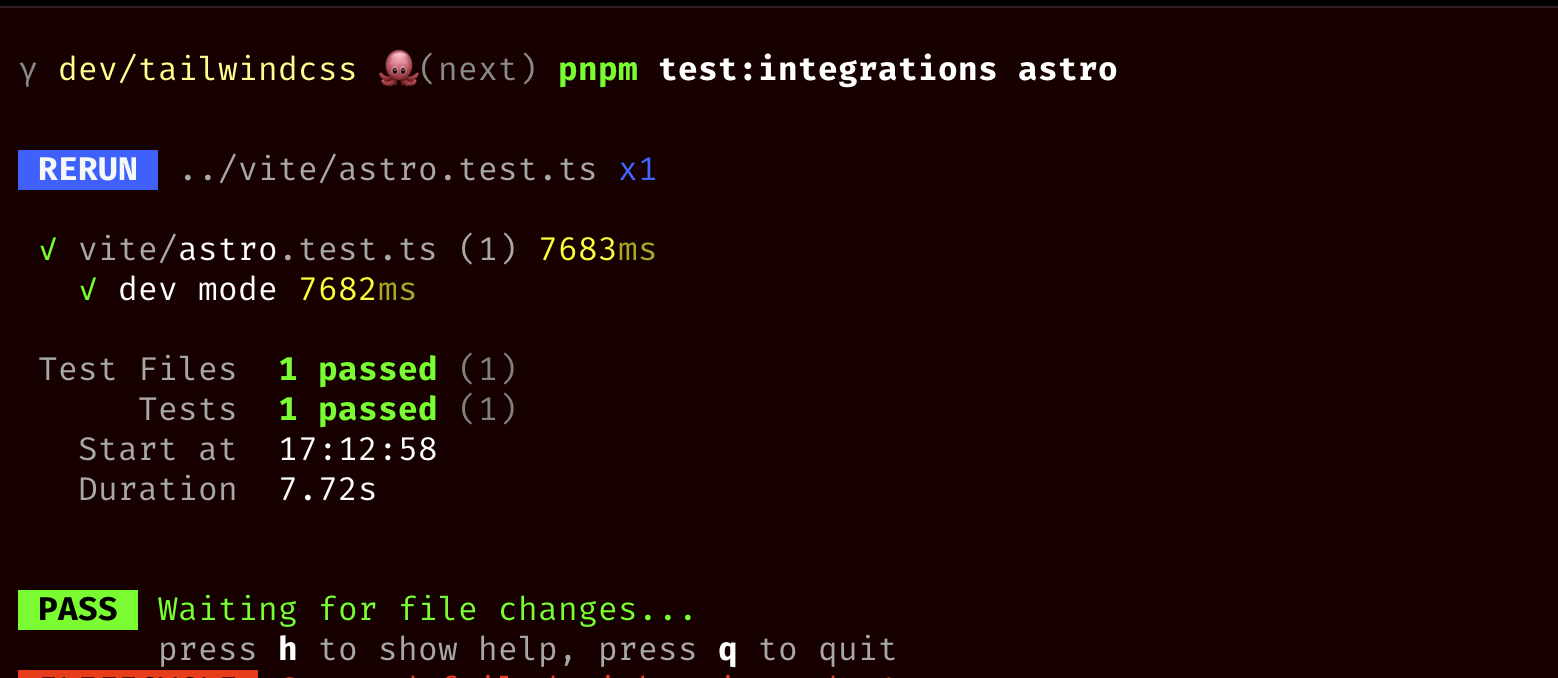
- Added an integration test for SolidStart dev mode
- Manually tested the dev mode across all Vite based templates in
https://github.com/philipp-spiess/tailwindcss-playgrounds: Astro, Nuxt,
Remix, Solid, SvelteKit, and Vue.
---------
Co-authored-by: Robin Malfait <malfait.robin@gmail.com>
Resolves#15722
This PR adds a list of ignored dependencies (in the current form only
`tailwind-merge`) to the Vite extension which, when included in the
dependency tree, are no longer scanned by the Tailwind CSS compiler for
candidates. This is to work around an issue where some dependencies
contain vast lists of valid Tailwind CSS class names which would
otherwise always be inlined in the build.
## Test plan
This was tested in our Vite playground on both dev and prod builds
across macOS and Windows:
### Windows prod build before

### Windows prod build after
This includes a debug `console.log(…)` to make sure it matches the right
module.

### Windows dev build after
This includes a debug `console.log(…)` to make sure it matches the right
module.

This PR replaces `@variant` with `@custom-variant` for registering
custom variants via your CSS.

In addition, this PR introduces `@variant` that can be used in your CSS
to use a variant while writing custom CSS.

E.g.:

```css
.btn {
  background: white;

  @variant dark {
    background: black;
  }
}
```

Compiles to:

```css
.btn {
  background: white;
}

@media (prefers-color-scheme: dark) {
  .btn {
    background: black;
  }
}
```

For backwards compatibility, the `@variant` rules that don't have a body
and are
defined inline:

```css
@variant hocus (&:hover, &:focus);
```

And `@variant` rules that are defined with a body and a `@slot`:

```css
@variant hocus {
  &:hover, &:focus {
    @slot;
  }
}
```

Will automatically be upgraded to `@custom-variant` internally, so no
breaking changes are introduced with this PR.

---

TODO:
- [x] ~~Decide whether we want to allow multiple variants and if so,
what syntax should be used. If not, nesting `@variant <variant> {}` will
be the way to go.~~ Only a single `@variant <variant>` can be used, if
you want to use multiple, nesting should be used:

```css
.foo {
  @variant hover {
    @variant focus {
      color: red;
    }
  }
}
```
This PR improves the integration tests in two ways:
1. Make the integration tests more reliable and thus less flakey
2. Make the integration tests faster (by introducing concurrency)

Tried a lot of different things to make sure that these tests are fast
and stable.

---

The biggest issue we noticed is that some tests are flakey, these are
tests with long running dev-mode processes where watchers are being used
and/or dev servers are created.
To solve this, all the tests that spawn a process look at stdout/stderr
and wait for a message from the process to know whether we can start
making changes.

For example, in case of an Astro project, you get a `watching for file
changes` message. In case of Nuxt project you can wait for an `server
warmed up in` and in case of Next.js there is a `Ready in` message.

These depend on the tools being used, so this is hardcoded per test
instead of a magically automatic solution.

These messages allow us to wait until all the initial necessary work,
internal watchers and/or dev servers are setup before we start making
changes to the files and/or request CSS stylesheets before the server(s)
are ready.

---

Another improvement is how we setup the dev servers. Before, we used to
try and get a free port on the system and use a `--port` flag or a
`PORT` environment variable. Instead of doing this (which is slow), we
rely on the process itself to show a URL with a port. Basically all
tools will try to find a free port if the default port is in use. We can
then use the stdout/stderr messages to get the URL and the port to use.

To reduce the amount of potential conflicts in ports, we used to run
every test and every file sequentially to basically guarantee that ports
are free. With this new approach where we rely on the process, I noticed
that we don't really run into this issue again (I reran the tests
multiple times and they were always stable)

<img width="316" alt="image"
src="https://github.com/user-attachments/assets/b75ddab4-f919-4995-85d0-f212b603e5c2"
/>
Note: these tests run Linux, Windows and macOS in this branch just for
testing purposes. Once this is done, we will only run Linux tests on PRs
and run all 3 of them on the `next` branch.

We do make the tests concurrent by default now, which in theory means
that there could be conflicts (which in practice means that the process
has to do a few more tries to find a free port). To reduce these
conflicts, we split up the integration tests such that Vite, PostCSS,
CLI, … tests all run in a separate job in the GitHub actions workflow.

<img width="312" alt="image"
src="https://github.com/user-attachments/assets/fe9a58a1-98eb-4d9b-8845-a7c8a7af5766"
/>

Comparing this branch against the `next` branch, this is what CI looks
like right now:

| `next` | `feat/improve-integration-tests` |
| --- | --- |
| <img width="594" alt="image"
src="https://github.com/user-attachments/assets/540d21eb-ab03-42e8-9f6f-b3a071fc7635"
/> | <img width="672" alt="image"
src="https://github.com/user-attachments/assets/8ef2e891-08a1-464b-9954-4153174ebce7"
/> |

There also was a point in time where I introduced sequential tests such
that all spawned processes still run after each other, but so far I
didn't run into issues if we keep them concurrent so I dropped that
code.

Some small changes I made to make things more reliable:
1. When relying on stdout/stderr messages, we split lines on `\n` and we
strip all the ANSI escapes which allows us to not worry about special
ANSI characters when finding the URL or a specific message to wait for.
2. Once a test is done, we `child.kill()` the spawned process. If that
doesn't work, for whatever reason, we run a `child.kill('SIGKILL')` to
force kill the process. This could technically lead to some memory or
files not being cleaned up properly, but once CI is done, everything is
thrown away anyway.
3. As you can see in the screenshots, I used some nicer names for the
workflows.

| `next` | `feat/improve-integration-tests` |
| --- | --- |
| <img width="276" alt="image"
src="https://github.com/user-attachments/assets/e574bb53-e21b-4619-9cdb-515431b255b9"
/> | <img width="179" alt="image"
src="https://github.com/user-attachments/assets/8bc75119-fb91-4500-a1d0-bd09f74c93ad"
/> |

They also look a bit nicer in the PR overview as well:
<img width="929" alt="image"
src="https://github.com/user-attachments/assets/04fc71fc-74b0-4e7c-9047-2aada664efef"
/>

The very last commit just filters out Windows and macOS tests again for
PRs (but they are executed on the `next` branch.

---

### Nest steps

I think for now we are in a pretty good state, but there are some things
we can do to further improve everything (mainly make things faster) but
aren't necessary. I also ran into issue while trying it so there is more
work to do.

1. More splits — instead of having a Vite folder and PostCSS folder, we
can go a step further and have folders for Next.js, Astro, Nuxt, Remix,
…
2. Caching — right now we have to run the build step for every OS on
every "job". We can re-use the work here by introducing a setup job that
the other jobs rely on. @thecrypticace and I tried it already, but were
running into some Bun specific Standalone CLI issues when doing that.
3. Remote caching — we could re-enable remote caching such that the
`build` step can be full turbo (e.g.: after a PR is merged in `next` and
we run everything again)
Closes#15219
This PR adds a new feature, `@import "…" reference` that can be used to
load Tailwind CSS configuration files without adding any style rules to
the CSS.
The idea is that you can use this in combination with your Tailwind CSS
root file when you need to have access to your full CSS config outside
of the main stylesheet. A common example is for Vue, Svelte, or CSS
modules:
```css
@import "./tailwind.css" reference;
.link {
@apply underline;
}
```
Importing a file as a reference will convert all `@theme` block to be
`reference`, so no CSS variables will be emitted. Furthermore it will
strip out all custom styles from the stylesheet. Furthermore plugins
registered via `@plugin` or `@config` inside reference-mode files will
not add any content to the CSS file via `addBase()`.
## Test Plan
Added unit test for when we handle the import resolution and when
`postcss-import` does it outside of Tailwind CSS. I also changed the
Svelte and Vue integration tests to use this new syntax to ensure it
works end to end.
---------
Co-authored-by: Jordan Pittman <jordan@cryptica.me>
Closes#15250
This PR simplifies our Vite integration even more. It turns out that in
some projects (see #15250 for the exact repro), the way we invoke
`svelte-preprocess` was actually causing issues in Vite since with Vite,
it's expected to use the `sveltePreprocess` version exported by
`sveltejs/vite-plugin-svelte`.
While trying to change this we noticed that there are different versions
of `sveltejs/vite-plugin-svelte` for Vite 5 and Vite 6 which caused us
to investigate even more and we noticed that we do not even need to
recursively call into the `sveltePreprocess()` as every plugin is run
after each other anyways. This allows us to drop the dependency on
`svelte-preprocess` and simplify the code a bit more, registering only a
`(string) => string` style transformer.
## Test Plan
This was tsted on the repro repo from #15250 as well as the SvelteKit
setup from [my
playgrounds](https://github.com/philipp-spiess/tailwindcss-playgrounds).
Furthermore we tested various combinations of `svelte`,
`@sveltejs/vite-plugin-svelte` and `vite` in our integration test to
ensure everything works as expected.
---------
Co-authored-by: Jordan Pittman <jordan@cryptica.me>
Closes#15159
This PR extends the `@tailwindcss/node` packages to be able to overwrite
the CSS and JS resolvers. This is necessary as some bundlers, in
particular Vite, have a custom module resolution system that can be
individually configured. E.g. in Vite it is possible to add custom
[resolver
configs](https://vite.dev/config/shared-options.html#resolve-conditions)
that is expected to be taken into account.
With the new `customCssResolver` and `customJsResolver` option, we're
able to use the Vite resolvers which take these configs into account.
## Test Plan
Tested in the playground by configuring [resolver
conditions](https://vite.dev/config/shared-options.html#resolve-conditions)
(with Vite 5.4 and Vite 6 beta). An integration test was added for both
the JS and CSS resolvers to ensure it keeps working as expected.
---------
Co-authored-by: Adam Wathan <adam.wathan@gmail.com>
This PR updates all our Vite dependencies to the newly released v6.
Nothing changed in our released Vite extension so this does not need a
user-facing changelog.

## Test Plan

The Vite playground still works. Furthermore we have a pretty extensive
Vite integration test suite that now runs on v6.
Closes#14965
This PR changes the way we register Tailwind CSS as a Svelte
preprocessor when using the Vite plugin. The idea is to reduce the
bookkeeping for interacting with CSS inside `<style>` tags so that we
have a more consistent behavior and make sure the Svelte-specific
post-processing (e.g. local class mangling) works as expected.
Prior to this change, we were running Tailwind CSS as a Svelte
preprocessor and then we would transform the file again when necessary
inside the Vite `transform` hook. This is necessary to have the right
list of candidates when we build the final CSS, but it did cause some
situation to not apply the Svelte post-processors anymore. The repro for
this seemed to indicate a timing specific issue and I did notice that
specifically the code where we invalidate modules in Vite would cause
unexpected processing orders.
We do, however, not officially support rendering utilities (`@tailwind
utilities;`) inside `<style>` tag. This is because the `<style>` block
is scoped by default and emitting utilities will always include
utilities for all classes in your whole project. For this case, we
highly recommend creating as separate `.css` file and importing it
explicitly.
With this limitation in place, the additional bookkeeping where we need
to invalidate modules because the candidate list has changed is no
longer necessary and removing it allows us to reduce the complexity of
the Svelte integration.
## Test Plan
https://github.com/user-attachments/assets/32c8e91f-ab21-48c6-aeaf-2582273b9bac
Not seen in the test plan above I also tested the `pnpm build --watch`
step of the Vite project. This does require the `pnpm preview` server to
restart but the build artifact are updated as expected.
Closes#13305
This PR adds registers a Svelte preprocessor, used by the Svelte Vite
plugin, to run Tailwind CSS for styles inside the `<style>` block, this
enables users to use Tailwind CSS features like `@apply` from inside
Svelte components:
```svelte
<script>
let name = 'world'
</script>
<h1 class="foo underline">Hello {name}!</h1>
<style global>
@import 'tailwindcss/utilities';
@import 'tailwindcss/theme' theme(reference);
@import './components.css';
</style>
```
## Test Plan
I've added integration tests to validate this works as expected.
Furthermore I've used the
[tailwindcss-playgrounds](https://github.com/philipp-spiess/tailwind-playgrounds)
SvelteKit project to ensure this works in an end-to-end setup:
<img width="2250" alt="Screenshot 2024-11-08 at 14 45 31"
src="https://github.com/user-attachments/assets/64e9e0f3-53fb-4039-b0a7-3ce945a29179">
This ensures our glob hoisting mechanism (see #14896) works on Windows
when performing an upgrade.

---------

Co-authored-by: Jordan Pittman <jordan@cryptica.me>
Fixes: #14839Fixes: #14796
This PR fixes an issue in the Vite extension where we previously only
ran a small list of allow-listed plugins for the second stage transform
in the build step. This caused some CSS features to unexpectedly not
work in production builds (one such example is Vue's `:deep(...)`
selector).
To fix this, I changed the allow listed plugins that we do want to run
to a block list to filter out some plugins we know we don't want to run
(e.g. the Tailwind Vite plugin for example or some built-in Vite plugins
that are not necessary).
## Test plan
This PR adds a new integration test suite to test interop with a custom
Vite transformer that looks like this:
```js
{
name: 'recolor',
transform(code, id) {
if (id.includes('.css')) {
return code.replace(/red/g, 'blue')
}
},
}
```
I also validated that this does indeed fix the Vue `:deep(...)` selector
related issue that we were seeing by copying the repro of #14839 into
our playground:

You can see in the screenshot above that the `:deep()` selector
overwrites the scoped styles as expected in both the dev mode and the
prod build (screenshotted).
Furthermore I reproduced the issue reported in
https://github.com/tailwindlabs/tailwindcss/issues/14796 and was able to
confirm that in a production build, the styling works as expected:
<img width="517" alt="Screenshot 2024-11-06 at 14 26 50"
src="https://github.com/user-attachments/assets/ade6fe38-be0d-4bd0-9a9a-67b6fec05ae0">
Lastly, I created a repository out of the biggest known-to-me Vite
projects: [Astro, Nuxt, Remix, SolidStart, and
SvelteKit](https://github.com/philipp-spiess/tailwind-playgrounds) and
verified that both dev and prod builds show no issue and the candidate
list is properly appended in each case.
---------
Co-authored-by: Jordan Pittman <jordan@cryptica.me>
Co-authored-by: Adam Wathan <adam.wathan@gmail.com>
Fixes#14784
This is an alternative to #14850 in which we actually perform url
rewriting / rebasing ourselves. We ported a large portion of the
URL-rewriting code from Vite (with attribution) to use here with some
minor modifications. We've added test cases for the url rewriting so
verifying individual cases is easy. We also wrote integration tests for
Vite that use PostCSS and Lightning CSS that verify that files are found
and inlined or relocated/renamed as necessary.
We also did some manual testing in the Playground to verify that this
works as expected across several CSS files and directories which you can
see a screenshot from here:
<img width="1344" alt="Screenshot 2024-11-05 at 10 25 16"
src="https://github.com/user-attachments/assets/ff0b3ac8-cdc9-4e26-af79-36396a5b77b9">
---------
Co-authored-by: Philipp Spiess <hello@philippspiess.com>
This PR changes how we render `var(...)` calls for theme values,
removing the fallback values we were previously including.

```diff
  .text-white {
-   color: var(--color-white, #fff);
+   color: var(--color-white);
  }
```

We previously included the fallbacks only so you could see the value in
dev tools but this feels like a bad reason to bloat the CSS. I'd rather
just convince the Chrome team to surface this stuff better in dev tools
in the first place.

---------

Co-authored-by: Adam Wathan <4323180+adamwathan@users.noreply.github.com>
This PR fixes an issue where a `@source` crashes when the path
eventually resolves to a path ending in `..`.

We have to make sure that we canonicalize the path to make sure that we
are working with the real directory.

---------

Co-authored-by: Jordan Pittman <jordan@cryptica.me>
This PR introduces a new `source(…)` argument and improves on the
existing `@source`. The goal of this PR is to make the automatic source
detection configurable, let's dig in.

By default, we will perform automatic source detection starting at the
current working directory. Auto source detection will find plain text
files (no binaries, images, ...) and will ignore git-ignored files.

If you want to start from a different directory, you can use the new
`source(…)` next to the `@import "tailwindcss/utilities"
layer(utilities) source(…)`.

E.g.:

```css
/* ./src/styles/index.css */
@import 'tailwindcss/utilities' layer(utilities) source('../../');
```

Most people won't split their source files, and will just use the simple
`@import "tailwindcss";`, because of this reason, you can use
`source(…)` on the import as well:

E.g.:

```css
/* ./src/styles/index.css */
@import 'tailwindcss' source('../../');
```

Sometimes, you want to rely on auto source detection, but also want to
look in another directory for source files. In this case, yuo can use
the `@source` directive:

```css
/* ./src/index.css */
@import 'tailwindcss';

/* Look for `blade.php` files in `../resources/views` */
@source '../resources/views/**/*.blade.php';
```

However, you don't need to specify the extension, instead you can just
point the directory and all the same automatic source detection rules
will apply.

```css
/* ./src/index.css */
@import 'tailwindcss';

@source '../resources/views';
```

If, for whatever reason, you want to disable the default source
detection feature entirely, and only want to rely on very specific glob
patterns you define, then you can disable it via `source(none)`.

```css
/* Completely disable the default auto source detection */
@import 'tailwindcss' source(none);

/* Only look at .blade.php files, nothing else  */
@source "../resources/views/**/*.blade.php";
```

Note: even with `source(none)`, if your `@source` points to a directory,
then auto source detection will still be performed in that directory. If
you don't want that, then you can simply add explicit files in the globs
as seen in the previous example.

```css
/* Completely disable the default auto source detection */
@import 'tailwindcss' source(none);

/* Run auto source detection in `../resources/views` */
@source "../resources/views";
```

---------

Co-authored-by: Jordan Pittman <jordan@cryptica.me>
Co-authored-by: Adam Wathan <4323180+adamwathan@users.noreply.github.com>
Fixes: #14558

This PR fixes an issue where our Vite plugin would crash when trying to load stylesheets via certain static asset query parameters:

```ts
import raw from './style.css?raw'
import url from './style.css?url'
```

The proper behavior for our extension is to _not touch these file at all_. The `?raw` identifier should never transform anything and the `?url` one will emit a module which points to the asset URL. However, if that URL is loaded as a stylesheet, another transform hook is called and the file is properly transformed. I verified this in the Vite setup and have added an integration test ensuring these two features work as expected.

I've also greatly reduced the complexity of the Vite playground to make it easier to set up examples like this in the future.
When your Vite or postcss project has multiple Tailwind CSS roots with
different configs, they should not influence each other (with the
exception of the same candidates being used).
There are still instances in which CI is flaky after #14332. This PR
applies the same fix (that is, moving the file write into the retrying
block) to all `retryAssertion` callbacks.
This works similar to the Vue setup. The styles that Astro will receive
might still contain Tailwind CSS APIs but since it's not picky, we can
pass that through to the regular Vite `transform` handlers for now.

This, however, will have issues like
https://github.com/tailwindlabs/tailwindcss/issues/14205. We have to fix
this together with Vue and other similar extensions later. For now, it
will break when syntax is used that lightningcss rewrites (like `@apply
text-3xl/tight;`)

---------

Co-authored-by: Jordan Pittman <jordan@cryptica.me>
I noticed the Windows integration tests for Vite's `watch` mode have
been flaky. Moving the file write into the retrying assertion callback
seems to fix it and allows us to get rid of the arbitrary timeout (I
don't remember that I ever added this in the first place 😅 ).
We noticed that Nuxt projects were not working with the tailwindcss
project. The issue was traced down to the fact that Nuxt starts multiple
Vite dev servers and calling the experimental `waitForRequestsIdle()` on
one of the test servers would never resolve.

This was fixed upstream and is part of the latest Vite/Nuxt release:
https://github.com/vitejs/vite/issues/17980.

We still need to handle the fact that Vite can spawn multiple dev
servers. This is necessary because when we invalidate all roots, we need
to find that module inside all of the spawned servers. If we only look
at the _last server_ (what we have done before), we would not find the
module and thus could not invalidate it.
Fixes#14205Fixes#14106
This PR reworks the Vite extension in order to supprt `lightningcss` as
the pre-processor, enable faster rebuilds, and adds support for `vite
build --watch` mode. To make this change possible, we've done two major
changes to the extension that have caused the other changes.
## 1. Tailwind CSS is a preprocessor
We now run all of our modifications in `enforce: 'pre'`. This means that
Tailwind CSS now gets the untransformed CSS files rather than the one
already going through postcss or lightningcss. We do this because
Tailwind CSS _is_ a preprocessor at the same level as those tools and we
do sometimes use the language in ways that [creates problems when it's
the input for other
bundlers](https://github.com/tailwindlabs/tailwindcss/pull/14269).
The correct solution here is to make Tailwind not depend on any other
transformations. The main reason we were not using the `enforce: 'pre'`
phase in Vite before was becuase we relied on the `@import` flattening
of postcss so we now have to do this manually. `@import` flattening is
now a concern that every Tailwind V4 client has to deal with so this
might actually be something we want to inline into tailwindcss in the
future.
## 2. A Vite config can have multiple Tailwind roots
This is something that we have not made very explicit in the previous
iteration of the Vite plugin but we have to support multiple Tailwind
roots in a single Vite workspace. A Tailwind root is a CSS file that is
used to configure Tailwind. Technically, any CSS file can be the input
for `tailwindcss` but you have to add certain rules (e.g. `@import
"tailwindcss";`) to make the compiler do something.
A workspace can have multiple of these rules (e.g. by having different
Tailwind configures for different sub-pages). With the addition of
[support for `@source`
rules](https://github.com/tailwindlabs/tailwindcss/pull/14078) and [JS
config files](https://github.com/tailwindlabs/tailwindcss/pull/14239),
Tailwind roots become more complex and can have a custom list of
_dependencies_ (that is other JavaScript modules the compiler includes
as part of these new rules). In order to _only rebuild the roots we need
to_, we have to make this separation very clear.
---------
Co-authored-by: Jordan Pittman <jordan@cryptica.me>
Co-authored-by: Adam Wathan <4323180+adamwathan@users.noreply.github.com>
When you configure custom content globs inside an `@config` file, we
want to tread these globs as being relative to that config file and not
the CSS file that requires the content file. A config can be used by
multiple CSS configs.

---------

Co-authored-by: Adam Wathan <adam.wathan@gmail.com>
In Tailwind v4 the CSS file is the main entry point to your project and
is generally configured via `@theme`. However, given that all v3
projects were configured via a `tailwind.config.js` file we definitely
need to support those. This PR adds support for loading existing
Tailwind config files by adding an `@config` directive to the CSS —
similar to how v3 supported multiple config files except that this is
now _required_ to use a config file.

You can load a config file like so:

```
@import "tailwindcss";
@config "./path/to/tailwind.config.js";
```

A few notes:
- Both CommonJS and ESM config files are supported (loaded directly via
`import()` in Node)
- This is not yet supported in Intellisense or Prettier — should
hopefully land next week
- TypeScript is **not yet** supported in the config file — this will be
handled in a future PR.

---------

Co-authored-by: Philipp Spiess <hello@philippspiess.com>
Co-authored-by: Adam Wathan <adam.wathan@gmail.com>
Co-authored-by: Robin Malfait <malfait.robin@gmail.com>
This PR fixes an issue introduced with the changed candidate cache
behavior in #14187.

Prior to #14187, candidates were cached globally within an instance of
Oxide. This meant that once a candidate was discovered, it would not
reset until you either manually cleared the cache or restarted the Oxide
process. With the changes in #14187 however, the cache was scoped to the
instance of the `Scanner` class with the intention of making the caching
behavior more easy to understand and to avoid a global cache.

This, however, had an unforeseen side-effect in our Vite extension.
Vite, in dev mode, discovers files _lazily_. So when a developer goes to
`/index.html` the first time, we will scan the `/index.html` file for
Tailwind candidates and then build a CSS file with those candidate. When
they go to `/about.html` later, we will _append_ the candidates from the
new file and so forth.

The problem now arises when the dev server detects changes to the input
CSS file. This requires us to do a re-scan of that CSS file which, after
#14187, caused the candidate cache to be gone. This is usually fine
since we would just scan files again for the changed candidate list but
in the Vite case we would only get the input CSS file change _but no
subsequent change events for all other files, including those currently
rendered in the browser_). This caused updates to the CSS file to remove
all candidates from the CSS file again.

Ideally, we can separate between two concepts: The candidate cache and
the CSS input file scan. An instance of the `Scanner` could re-parse the
input CSS file without having to throw away previous candidates. This,
however, would have another issue with the current Vite extension where
we do not properly retain instances of the `Scanner` class anyways. To
properly improve the cache behavior, we will have to fix the Vite
`Scanner` retaining behavior first. Unfortunately this means that for
the short term, we have to add some manual bookkeeping to the Vite
client and retain the candidate cache between builds ourselves.

---------

Co-authored-by: Jordan Pittman <jordan@cryptica.me>
Using the [new integration test
setup](https://github.com/tailwindlabs/tailwindcss/pull/14089), this PR
adds a test for a V4 Next.js setup using the Postcss plugin. It's
testing both a full build and the dev mode (non-turbo for now).

Because of webpack, tests are quite slow which is worrisome since we
probably need to add many more integrations in the future. One idea I
have is that we separate tests in two buckets: _essential_ tests that
run often and are fast and advanced suites that we only run on CI via
custom, non-blocking, jobs.

---------

Co-authored-by: Jordan Pittman <jordan@cryptica.me>
This PR adds support to transforming `<style>` blocks emitted by Vue
components with tailwindcss when the `@tailwindcss/vite` is used.

Example:

```vue
<style>
  @import 'tailwindcss/utilities';
  @import 'tailwindcss/theme' theme(reference);
  .foo {
    @apply text-red-500;
  }
</style>
<template>
 <div class="underline foo">Hello Vue!</div>
</template>
```

Additionally, this PR also adds an integration test.

---------

Co-authored-by: Robin Malfait <malfait.robin@gmail.com>
This PR is an umbrella PR where we will add support for the new
`@source` directive. This will allow you to add explicit content glob
patterns if you want to look for Tailwind classes in other files that
are not automatically detected yet.

Right now this is an addition to the existing auto content detection
that is automatically enabled in the `@tailwindcss/postcss` and
`@tailwindcss/cli` packages. The `@tailwindcss/vite` package doesn't use
the auto content detection, but uses the module graph instead.

From an API perspective there is not a lot going on. There are only a
few things that you have to know when using the `@source` directive, and
you probably already know the rules:

1. You can use multiple `@source` directives if you want.
2. The `@source` accepts a glob pattern so that you can match multiple
files at once
3. The pattern is relative to the current file you are in
4. The pattern includes all files it is matching, even git ignored files
1. The motivation for this is so that you can explicitly point to a
`node_modules` folder if you want to look at `node_modules` for whatever
reason.
6. Right now we don't support negative globs (starting with a `!`) yet,
that will be available in the near future.

Usage example:

```css
/* ./src/input.css */
@import "tailwindcss";
@source "../laravel/resources/views/**/*.blade.php";
@source "../../packages/monorepo-package/**/*.js";
```

It looks like the PR introduced a lot of changes, but this is a side
effect of all the other plumbing work we had to do to make this work.
For example:

1. We added dedicated integration tests that run on Linux and Windows in
CI (just to make sure that all the `path` logic is correct)
2. We Have to make sure that the glob patterns are always correct even
if you are using `@import` in your CSS and use `@source` in an imported
file. This is because we receive the flattened CSS contents where all
`@import`s are inlined.
3. We have to make sure that we also listen for changes in the files
that match any of these patterns and trigger a rebuild.

PRs:

- [x] https://github.com/tailwindlabs/tailwindcss/pull/14063
- [x] https://github.com/tailwindlabs/tailwindcss/pull/14085
- [x] https://github.com/tailwindlabs/tailwindcss/pull/14079
- [x] https://github.com/tailwindlabs/tailwindcss/pull/14067
- [x] https://github.com/tailwindlabs/tailwindcss/pull/14076
- [x] https://github.com/tailwindlabs/tailwindcss/pull/14080
- [x] https://github.com/tailwindlabs/tailwindcss/pull/14127
- [x] https://github.com/tailwindlabs/tailwindcss/pull/14135

Once all the PRs are merged, then this umbrella PR can be merged.

> [!IMPORTANT]
> Make sure to merge this without rebasing such that each individual PR
ends up on the main branch.

---------

Co-authored-by: Philipp Spiess <hello@philippspiess.com>
Co-authored-by: Jordan Pittman <jordan@cryptica.me>
Co-authored-by: Adam Wathan <adam.wathan@gmail.com>
This PR adds a new root `/integrations` folder that will be the home of
integration tests. The idea of these tests is to use Tailwind in various
setups just like our users would (by only using the publishable npm
builds).

To avoid issues with concurrent tests making changes to the file system,
to make it very easy to test through a range of versions, and to avoid
changing configuration objects over and over in test runs, we decided to
inline the scaffolding completely into the test file and have no
examples checked into the repo.

Here's an example of how this can look like for a simple Vite test:

```ts
test('works with production builds', {
    fs: {
      'package.json': json`
        {
          "type": "module",
          "dependencies": {
            "@tailwindcss/vite": "workspace:^",
            "tailwindcss": "workspace:^"
          },
          "devDependencies": {
            "vite": "^5.3.5"
          }
        }
      `,
      'vite.config.ts': ts`
        import tailwindcss from '@tailwindcss/vite'
        import { defineConfig } from 'vite'

        export default defineConfig({
          build: { cssMinify: false },
          plugins: [tailwindcss()],
        })
      `,
      'index.html': html`
        <head>
          <link rel="stylesheet" href="./src/index.css">
        </head>
        <body>
          <div class="underline m-2">Hello, world!</div>
        </body>
      `,
      'src/index.css': css`
        @import 'tailwindcss/theme' reference;
        @import 'tailwindcss/utilities';
      `,
    },
  },
  async ({ fs, exec }) => {
    await exec('pnpm vite build')

    expect.assertions(2)
    for (let [path, content] of await fs.glob('dist/**/*.css')) {
      expect(path).toMatch(/\.css$/)
      expect(stripTailwindComment(content)).toMatchInlineSnapshot(
        `
        ".m-2 {
          margin: var(--spacing-2, .5rem);
        }

        .underline {
          text-decoration-line: underline;
        }"
      `,
      )
    }
  },
)
```

By defining all dependencies this way, we never have to worry about
which fixtures are checked in and can more easily describe changes to
the setup.

For ergonomics, we've also added the [`embed` prettier
plugin](https://github.com/Sec-ant/prettier-plugin-embed). This will
mean that files inlined in the `fs` setup are properly indented. No
extra work needed!

If you're using VS Code, I can also recommend the [Language
Literals](https://marketplace.visualstudio.com/items?itemName=sissel.language-literals)
extension so that syntax highlighting also _just works_.

A neat feature of inlining the scaffolding like this is to make it very
simple to test through a variety of versions. For example, here's how we
can set up a test against Vite 5 and Vite 4:

```js
;['^4.5.3', '^5.3.5'].forEach(viteVersion => {
    test(`works with production builds for Vite ${viteVersion}`, {
      fs: {
        'package.json': json`
          {
            "type": "module",
            "devDependencies": {
              "vite": "${viteVersion}"
            }
          }
        `,
    async () => {
      // Do something
    },
  )
})
```

## Philosophy

Before we dive into the specifics, I want to clearly state the design
considerations we have chosen for this new test suite:

- All file mutations should be done in temp folders, nothing should ever
mess with your working directory
- Windows as a first-class citizen
- Have a clean and simple API that describes the test setup only using
public APIs
- Focus on reliability (make sure cleanup scripts work and are tolerant
to various error scenarios)
- If a user reports an issue with a specific configuration, we want to
be able to reproduce them with integration tests, no matter how obscure
the setup (this means the test need to be in control of most of the
variables)
- Tests should be reasonably fast (obviously this depends on the
integration. If we use a slow build tool, we can't magically speed it
up, but our overhead should be minimal).

## How it works

The current implementation provides a custom `test` helper function
that, when used, sets up the environment according to the configuration.
It'll create a new temporary directory and create all files, ensuring
things like proper `\r\n` line endings on Windows.

We do have to patch the `package.json` specifically, since we can not
use public versions of the tailwindcss packages as we want to be able to
test against a development build. To make this happen, every `pnpm
build` run now creates tarballs of the npm modules (that contain only
the files that would also in the published build). We then patch the
`package.json` to rewrite `workspace:^` versions to link to those
tarballs. We found this to work reliably on Windows and macOS as well as
being fast enough to not cause any issues. Furthermore we also decided
to use `pnpm` as the version manager for integration tests because of
it's global module cache (so installing `vite` is fast as soon as you
installed it once).

The test function will receive a few utilities that it can use to more
easily interact with the temp dir. One example is a `fs.glob` function
that you can use to easily find files in eventual `dist/` directories or
helpers around `spawn` and `exec` that make sure that processes are
cleaned up correctly.

Because we use tarballs from our build dependencies, working on changes
requires a workflow where you run `pnpm build` before running `pnpm
test:integrations`. However it also means we can run clients like our
CLI client with no additional overhead—just install the dependency like
any user would and set up your test cases this way.

## Test plan

This PR also includes two Vite specific integration tests: One testing a
static build (`pnpm vite build`) and one a dev mode build (`pnpm vite
dev`) that also makes changes to the file system and asserts that the
resources properly update.

---------

Co-authored-by: Robin Malfait <malfait.robin@gmail.com>
* bump `postcss-load-config` in the oxide engine

* bump `postcss-load-config` in the stable engine

* update changelog

* Switch to stable

* Update Node to v14

* Update to latest dependency versions

* Update test helper for new version of `rimraf`

Co-Authored-By: Jordan Pittman <jordan@cryptica.me>

* Downgrade `lightningcss` to `v1.18.0`

Co-Authored-By: Jordan Pittman <jordan@cryptica.me>

* Switch back to oxide

* Update Github actions from Node 12 to Node 14

* Update oxide dependencies

* Update stable dependencies

* Update `content-resolution` integration test dependencies

* Update `postcss-cli` integration test dependencies

* Update `rollup` integration test dependencies

* Update `rollup-sass` integration test dependencies

* Update `vite` integration test dependencies

* Update `webpack-5` integration test dependencies

* Update changelog

* Remove `color-name` dependency

* Replace `quick-lru` dependency with `@alloc/quick-lru`

* Replace `quick-lru` dependency with `@alloc/quick-lru` in stable

* Fix standalone CLI test

---------

Co-authored-by: Jonathan Reinink <jonathan@reinink.ca>
Co-authored-by: Jordan Pittman <jordan@cryptica.me>
* replace `env.OXIDE` with global `__OXIDE__`

This will allow us to replace the `__OXIDE__` at build time, and fully
remove the branches from the final code so that there is not even any
reference to `@tailwindcss/oxide` on the stable engine.

* update changelog

* use `env.ENGINE` in integration tests

* drop oxide branching for the PostCSS plugin for now

This is currently a redirect to the same file, so doesn't hurt.

* Enable better dead-code elimination

* Update CLI tests

Fix indentation

* Fix indentation

---------

Co-authored-by: Jordan Pittman <jordan@cryptica.me>
* try to use `config.default` before using `config`

* update changelog

* add quick `SHOW_OUTPUT` toggle for integration tests

Setting this to `true` shows the output of the executed commands.

* add integration tests for `tailwind.config.ts` and `tailwind.config.js` with ESM syntax
* disable color opacity plugins by default for the `oxide` engine

* update tests to reflect this change in the `oxide` engine

* update changelog

* reflect changes in integration tests