 da6ae08851
* Update README.pt-BR.md

* TRIE README.pt-BR typo

* TREE README.pt-BR typo

* Stack README.pt-BR typo

* Priority Queue README.pt-BR typo

* hash-table README.pt-BR typo

* doubly-linked-list README.pt-BR typo

* disjoint-set README.pt-BR typo

* bloom-filter README.pt-BR typo

* merge-sort pt-BR translation

* merge-sort README added pt-BR option

* insertion sort pt-BR translation

* insertion sort README added pt-br option

* heap-sort pt-BR translation

* heap-sort READMED added pt-BR option

* bubble sort pt-BR typo

* pt-BR translation for sorting algorithms

Fixed typos and translated all the missing algorithms

* Update README.pt-BR.md

* linked list pt-BR translation

* ml pt-BR translation

* fix typo in README

Co-authored-by: Oleksii Trekhleb <trehleb@gmail.com>
Tree
Read this in other languages: 简体中文, Português
- Binary Search Tree
- AVL Tree
- Red-Black Tree
- Segment Tree - with min/max/sum range queries examples
- Fenwick Tree (Binary Indexed Tree)
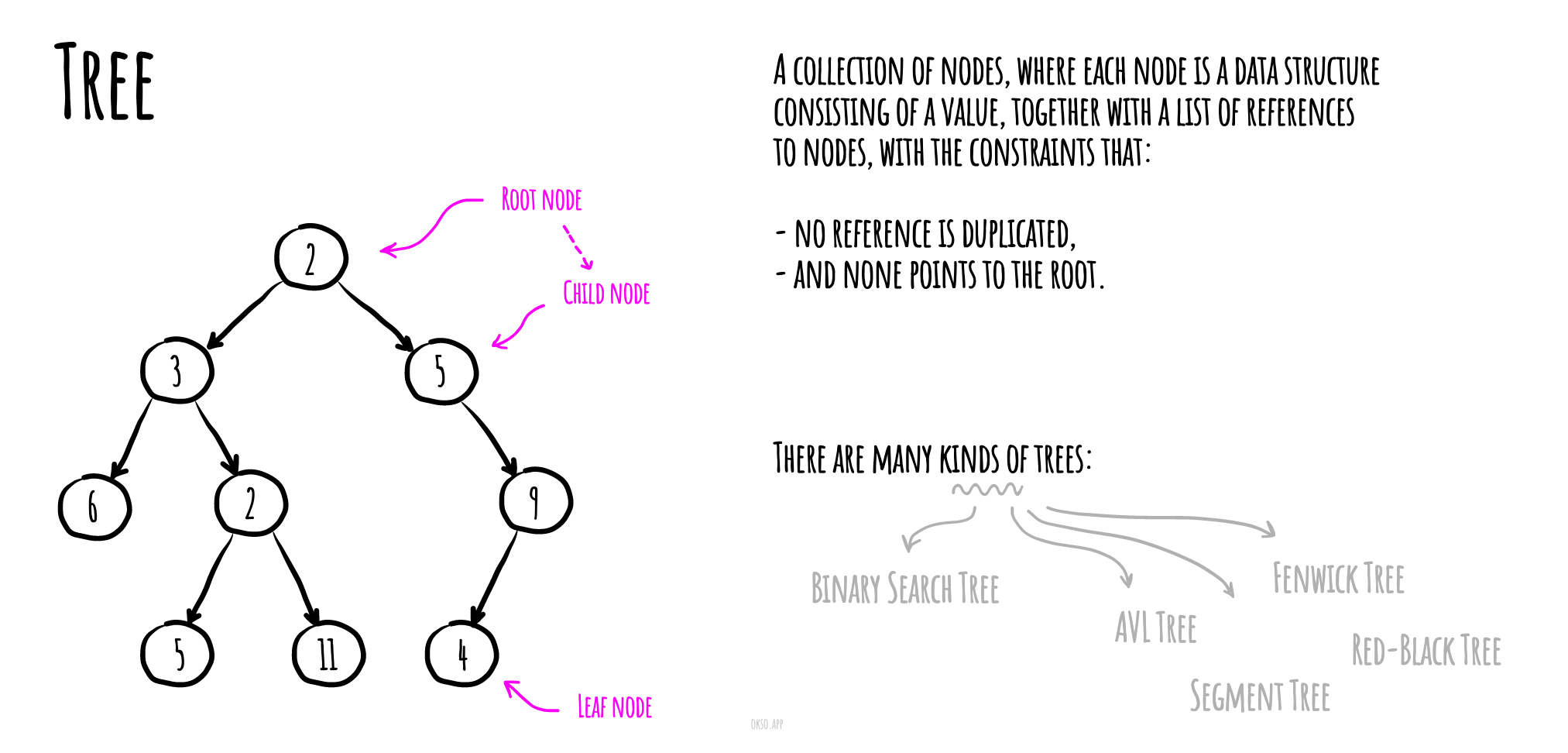
In computer science, a tree is a widely used abstract data type (ADT) — or data structure implementing this ADT—that simulates a hierarchical tree structure, with a root value and subtrees of children with a parent node, represented as a set of linked nodes.
A tree data structure can be defined recursively (locally) as a collection of nodes (starting at a root node), where each node is a data structure consisting of a value, together with a list of references to nodes (the "children"), with the constraints that no reference is duplicated, and none points to the root.
A simple unordered tree; in this diagram, the node labeled 7 has two children, labeled 2 and 6, and one parent, labeled 2. The root node, at the top, has no parent.
Made with okso.app