 da6ae08851
* Update README.pt-BR.md

* TRIE README.pt-BR typo

* TREE README.pt-BR typo

* Stack README.pt-BR typo

* Priority Queue README.pt-BR typo

* hash-table README.pt-BR typo

* doubly-linked-list README.pt-BR typo

* disjoint-set README.pt-BR typo

* bloom-filter README.pt-BR typo

* merge-sort pt-BR translation

* merge-sort README added pt-BR option

* insertion sort pt-BR translation

* insertion sort README added pt-br option

* heap-sort pt-BR translation

* heap-sort READMED added pt-BR option

* bubble sort pt-BR typo

* pt-BR translation for sorting algorithms

Fixed typos and translated all the missing algorithms

* Update README.pt-BR.md

* linked list pt-BR translation

* ml pt-BR translation

* fix typo in README

Co-authored-by: Oleksii Trekhleb <trehleb@gmail.com>
k-Nearest Neighbors Algorithm
Read this in other languages: Português
The k-nearest neighbors algorithm (k-NN) is a supervised Machine Learning algorithm. It's a classification algorithm, determining the class of a sample vector using a sample data.
In k-NN classification, the output is a class membership. An object is classified by a plurality vote of its neighbors, with the object being assigned to the class most common among its k nearest neighbors (k is a positive integer, typically small). If k = 1, then the object is simply assigned to the class of that single nearest neighbor.
The idea is to calculate the similarity between two data points on the basis of a distance metric. Euclidean distance is used mostly for this task.
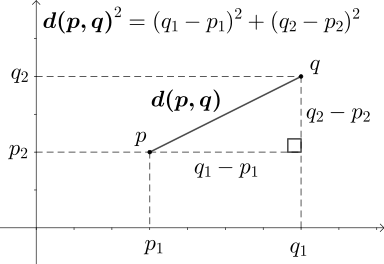
Image source: Wikipedia
The algorithm is as follows:
- Check for errors like invalid data/labels.
- Calculate the euclidean distance of all the data points in training data with the classification point
- Sort the distances of points along with their classes in ascending order
- Take the initial
Kclasses and find the mode to get the most similar class - Report the most similar class
Here is a visualization of k-NN classification for better understanding:

Image source: Wikipedia
The test sample (green dot) should be classified either to blue squares or to red triangles. If k = 3 (solid line circle) it is assigned to the red triangles because there are 2 triangles and only 1 square inside the inner circle. If k = 5 (dashed line circle) it is assigned to the blue squares (3 squares vs. 2 triangles inside the outer circle).
Another k-NN classification example:
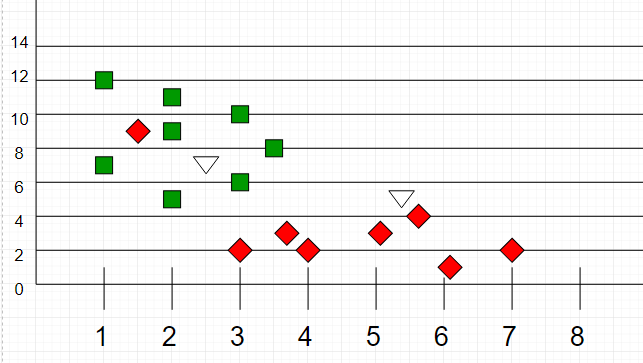
Image source: GeeksForGeeks
Here, as we can see, the classification of unknown points will be judged by their proximity to other points.
It is important to note that K is preferred to have odd values in order to break ties. Usually K is taken as 3 or 5.